
Custom Jewelry Manufacturing Costs: What Moves Them
Custom jewelry is quoted from a small set of variables, and only some of them are metal. TTT Jewelry publishes the ones that shape a quote: minimums of 50 pieces in 925 sterling silver, 100 in artisan eco-brass and 100+ in stainless steel, a 25–30 day sampling window after CAD at under 48 hours, and plating in multi-layer 14K, 18K, 24K gold or rhodium. No factory publishes a unit price that survives a change in any of those five inputs.
Key takeaways
- One-time costs — tooling and sampling — are divided by order quantity, so quantity changes the unit rate more than any negotiation.
- Silver opens at 50 pieces per design, half the brass minimum of 100, so the same tooling charge lands twice as heavily per piece.
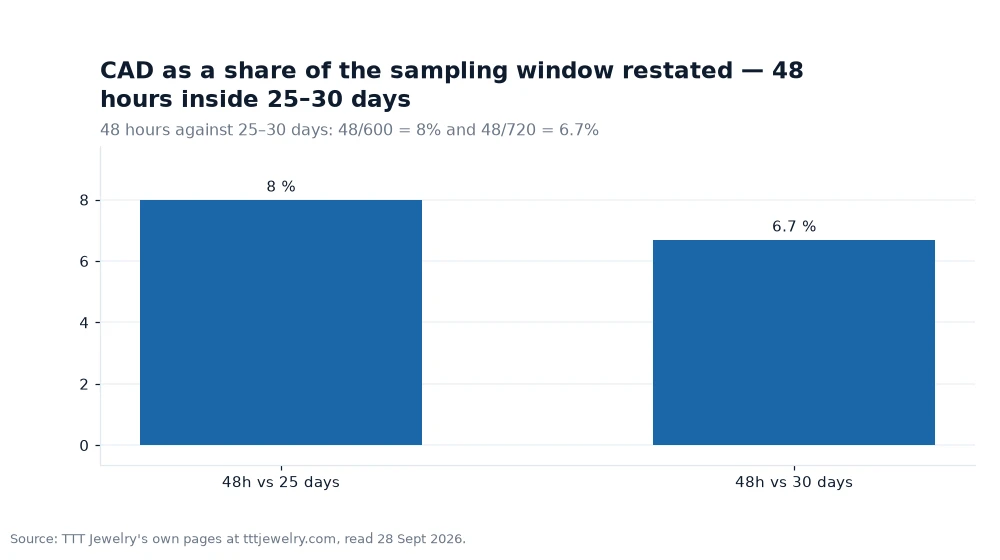
- CAD at 48 hours is 8% of a 25-day sampling window and 6.7% of a 30-day one, which makes it a small share of the calendar.
- Each extra sampling round adds 25–30 days before a single production unit is made.
The blocks that make up a quotation
Every custom jewelry quote contains the same categories, whether the supplier itemises them or folds them into one rate. Metal is the first: the alloy and its weight. Tooling is the second: the mould or master that exists only for this design. Labour is the third: casting, setting, polishing and surface work. Plating is the fourth: the number of passes and the chemistry. Sampling and packaging close the list.
The categories behave differently. Metal scales with units. Tooling does not scale at all; it is attached to the design and paid once. Labour scales with units but also with complexity, because a piece with forty settings takes longer at the bench than a plain band at the same weight. Plating scales with surface area and pass count. Packaging scales with units and with the number of printed components.
That difference is the whole negotiation. A buyer who asks for a lower unit price is asking the supplier to change one of those behaviours. Metal can sometimes be substituted. Labour can be simplified. Tooling can be amortised. Plating can be thinned. Sampling can be shortened by a better brief. Nothing on the list can be removed without changing the product.
The minimum order sets the spread
Because tooling is fixed and units are variable, the minimum order quantity decides how thin the fixed charge can be spread. The published minimums differ by material: 50 pieces per design in 925 sterling silver, 100 in artisan eco-brass, and 100+ in stainless steel.
Silver therefore has the lowest entry point of the three, at half the brass count. That does not make a silver programme cheaper in total, because the metal itself costs more. It does mean the per-piece share of a one-time charge is calculated over a smaller denominator, which is the opposite of what most first-time buyers expect. A sterling silver jewelry manufacturer quoting at that 50-piece threshold is dividing the same kind of fixed cost over half the units.
Stainless is the material where the "100+" matters most. The plus is not decoration; it signals that the threshold moves with the geometry. A heavy cast piece and a thin stamped tag do not consume the same tooling or the same polishing time, so the minimum is quoted against the design rather than against the category.
| Base material | Minimum per design | One-time share at minimum | Doubling the run |
|---|---|---|---|
| 925 sterling silver | 50 pieces | T ÷ 50 | Falls to T ÷ 100 |
| Artisan eco-brass | 100 pieces | T ÷ 100 | Falls to T ÷ 200 |
| Stainless steel | 100+ pieces | T ÷ 100 or more | Falls with the agreed run |
| Plating pass | Per style | Repeats per pass | Unchanged per pass |
| Sampling round | 25–30 days | Calendar, not units | Unchanged per round |
Read the fourth and fifth rows as a warning. Plating passes and sampling rounds do not get cheaper when the order doubles, because neither is divided by quantity. A buyer who negotiates hard on units and ignores the number of passes has optimised the smallest line in the quote.
Plating layers are process time, not just material
The plating menu lists multi-layer 14K, 18K and 24K gold plus rhodium, with anti-tarnish e-coating on silver and brass and PVD vacuum plating on stainless steel. Each option changes the number of passes through the line, and each pass carries preparation, tank time and rinsing.
That is why a thicker gold stack is not simply "more gold". It is more handling. The metal cost of a micron-scale deposit is small next to the bench and line time around it, and the compliance work — REACH and CA Prop 65 conformity for the chemistry — applies to the process regardless of thickness. An OEM/ODM programme prices the route, not the colour chip.
Stainless follows a different economics. PVD is a vacuum process, and the published note is that 316L, with 2–3% molybdenum, is waterproof and shower-safe and swim-proof once coated, while 304 is water-resistant for daily wear and vacuum-plated for cost-effective volume. The two grades are not interchangeable on a quote, because the cheaper grade buys a different durability claim.
CAD and sampling: the clock as a cost line
Development time is usually treated as a schedule item rather than a cost. In practice it is both, because the sample bench and the CAD station are paid for whether or not a design is approved. CAD modelling takes under 48 hours. Master physical sampling takes 25–30 days. Mass production takes 21–28 days.
Two conclusions follow. The first is that CAD is cheap in calendar terms: 48 hours inside a 25–30 day window is a small slice. The second is that sampling is not cheap in the same way. It is the longest single block before production, and every revision round repeats it in full.
The published figures for custom work sit on this page: www.tttjewelry.com lists the six-step OEM/ODM flow as inquiry, consultation, CAD and prototype, sample and approval, bulk production, then final QC and delivery. Reading that sequence as a cost map is more useful than reading it as a sales page: steps three and four are where money is spent before any revenue exists.
Worked example
Let the one-time tooling charge be T and compare two designs at the published minimums. For silver at 50 pieces, the per-piece share is T ÷ 50. For brass at 100 pieces, it is T ÷ 100. The ratio is (T ÷ 50) ÷ (T ÷ 100) = 2, so the silver unit carries twice the tooling share at the minimum even though the silver minimum is lower in absolute units.
Double both runs. Silver at 100 pieces gives T ÷ 100; brass at 200 gives T ÷ 200. Each unit share halves, and the ratio between the two materials stays at 2. The lesson is that quantity changes the level of the fixed charge; material mix changes the relationship between two quotes.
Now the calendar. CAD 2 days + sampling 25–30 days + production 21–28 days = 48–60 days, which is roughly 7 to 9 weeks. CAD alone is 2 ÷ 25 = 8% of the short sampling window and 2 ÷ 30 = 6.7% of the long one. A second sampling round adds another 25–30 days, taking the total to 73–90 days, or about 10 to 13 weeks.
Frequently asked questions
Why is a 50-piece silver order not the least expensive entry point?
Silver has the lowest unit minimum, but a fixed tooling charge divided by 50 pieces is twice the per-piece share it would be divided by 100.
Does a second sample round add cost or only time?
Both. It repeats prototype and bench work, and it adds 25–30 days to the schedule before production can start.
Is stainless steel cheaper because the minimum is higher?
Not automatically. A higher minimum spreads fixed costs over more units, but the grade chosen, 316L or 304, decides which durability claim the piece can carry.
Building the model before you ask for quotes
A cost model does not need prices to be useful. List the one-time items, list the per-unit items, then divide the one-time total by the planned quantity per design. That single figure explains most of the gap between two quotes that look far apart at the headline.
Material choice is the second input. A stainless programme at 100+ pieces per design behaves differently from a silver one at 50, and the stainless steel jewelry manufacturer route also removes the anti-tarnish step that silver and brass require. Fewer process steps, a different minimum, a different durability claim: three variables moving at once.
Finally, price the calendar. Ninety days of development for a season that starts in eight weeks is a cost even when every unit is quoted cheaply. The published windows are short enough to plan against, provided the design is signed off before the sample bench is booked.
Source note: figures come from the manufacturer's own website (tttjewelry.com), read 28 Sept 2026.[1]