
Scoring a Custom Perfume Partner for a Refillable Range
A refillable range asks more of a supplier than a sealed bottle does, because the format depends on a mechanism, a fill tolerance and a release that all interact. Evaluating a partner on brochures and certificates misses the three things that decide the outcome. The scorecard below turns each of them into a question that produces evidence rather than an impression.
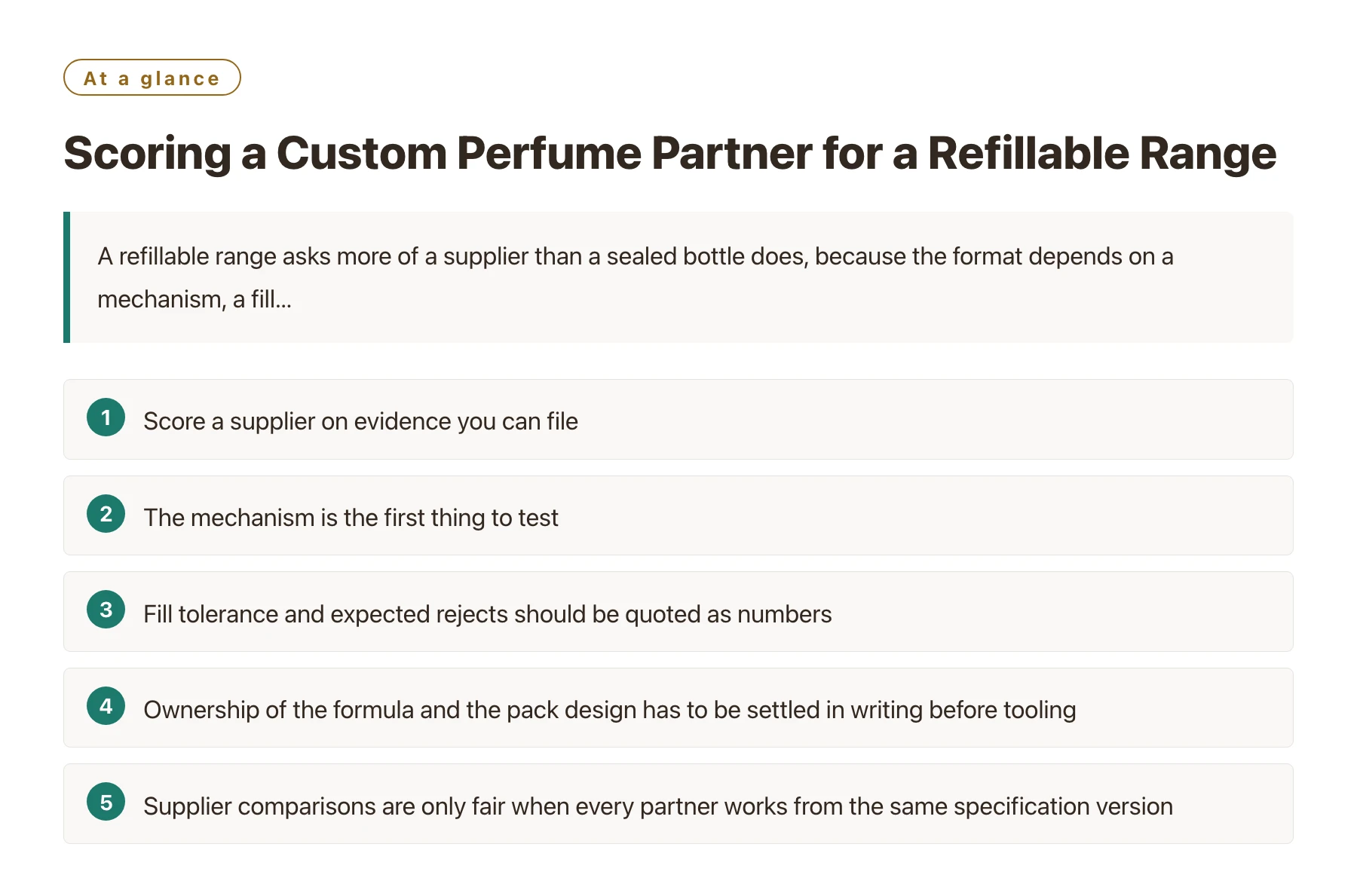
Key takeaways
- Score a supplier on evidence you can file, not on how the visit felt; a refillable programme is judged later by records, not by recollection.
- The mechanism is the first thing to test, because a partner that has never developed a refill interface is learning at the brand's expense.
- Fill tolerance and expected rejects should be quoted as numbers, since they translate directly into the unit cost of a good refill.
- Ownership of the formula and the pack design has to be settled in writing before tooling, because the answer is expensive to change afterwards.
- Supplier comparisons are only fair when every partner works from the same specification version, so version control is part of the evaluation.
Most supplier evaluations for fragrance work fail in the same way: they collect facts that are easy to obtain and avoid the questions that are hard to answer. Certificates, catalogues and factory photographs are the easy part, and none of them predicts what happens when a refill leaks.
A refillable range makes this visible because the number of interfaces grows. The fragrance meets the refill material, the refill meets the closure, the closure meets the vessel, and the filled unit meets the customer's hands. Every one of those interfaces is a place where a supplier's process either holds or does not.
The scorecard is deliberately narrow. It scores six things, and it treats a missing answer as a lower score than a confident-sounding answer with nothing behind it.
Six things worth scoring, and the evidence each one produces
| What you are scoring | Question that produces evidence | What a weak answer sounds like |
|---|---|---|
| Refill experience | Which refill interfaces have you filled, and what was the failure mode? | We can make anything you draw |
| Tolerance discipline | What fill tolerance can your line hold, and what reject rate follows? | Standard tolerance applies |
| Release documentation | Which records are issued with each batch, and can I see a blank template? | Full documentation is provided |
| Ownership terms | Who owns the formula, the pack design and the tooling after the order? | That is standard in our contract |
| Change control | How do you handle a material substitution or a supplier change? | We would inform you |
| Programme management | Who is my single point of contact, and what do they do besides sales? | Our team will coordinate |
One pattern is worth noting: every weak answer is a general statement, and every strong one is a name, a document or a number.
The three questions that decide the relationship
If time is short, these three carry most of the weight. They are also the three that buyers most often postpone until after a deposit, when the answers stop being negotiable.
Who owns what, in writing
Formula ownership, pack design ownership and tooling ownership are three separate questions that are often answered as one. Ownership of a design is an intellectual property matter, and the guidance published by bodies such as WIPO exists because the answer is far cheaper to fix on paper than after production [1].
Where the brand intends to sell across several markets, ownership interacts with registration and notification work. In the European Union a product needs a Responsible Person and a product information file, and the party holding those obligations usually needs access to formula detail [2].
A supplier that hands over a clear ownership schedule before the order is a different proposition from one that explains it verbally after.
Whether the mechanism has been filled before
Experience with a refill interface is not the same as experience with perfume. A partner that has run a similar mechanism knows which seal materials behave, how much torque the closure tolerates and where leaks normally appear.
This is the fastest question to ask and the hardest to fake. The follow-up, what went wrong and how was it fixed, is more informative than any list of capabilities, and it is the same instinct behind due diligence on a perfume manufacturer.
Whether the specification is shared and versioned
Comparing two suppliers is meaningless if each is quoting a different version of the brief. Establish a version number and circulate the same document to everyone in the running.
Where a brand is working with a partner in one country and selling in several, this discipline also protects the brand. A custom programme briefed to custom perfume manufacturer in China may travel further than the buyer expects, and the specification is what travels with it.
The same logic applies when the roles are split. Whether a brand is briefing a development partner or looking for a perfume production partner in China, the written specification is the only thing that keeps the two conversations describing the same product.
Running the evaluation before anyone visits a plant
- Fix the specification and the versionOne brief, one version number, sent to every candidate, so the answers can be compared.
- Ask for the evidence list, not the certificate listRequest a blank batch record, a change-control form and a specification template. What a supplier keeps is more telling than what it displays.
- Put the ownership questions in one documentFormula, design, tooling and artwork together, answered in writing before commercial terms are discussed.
- Ask for tolerance and reject expectations as numbersThese turn directly into unit cost, and a supplier that will not commit to a number is not ready for a refillable order.
- Check how each candidate describes past workPublished material such as Xuelei case studies is best read for process detail: what the brief was, what changed, what was tested.
- Shortlist on the weakest score, not the averageOn a refillable range, the weakest answer is the one that will cause the problem, so weight it accordingly.
A supplier that answers every question well and one that answers the ownership question vaguely are not close alternatives. On a refillable programme the vague answer is the risk, and it does not improve after the deposit is paid.
Sources
- WIPO — World Intellectual Property Organization —— The UN agency for intellectual property; resources on industrial design and patent protection relevant to product and packaging design.
- European Commission: Cosmetics in the EU —— The European Commission's overview of EU cosmetics rules, including the responsible person, product information file and safety report requirements.
Frequently asked questions
How many suppliers should a new brand evaluate?
Three is usually enough to compare without spreading the brand's attention too thin. More candidates rarely add information; they add timelines, because each one needs the same brief and the same follow-up questions.
Is a factory visit necessary before placing a first refillable order?
It is useful but not decisive. Documents and answers to follow-up questions predict more than a tour does, because a tour shows a good day while a batch record shows a normal one.
What should the brand do when two suppliers score similarly?
Compare the weakest score on each side rather than the total. If one is weak on tolerance and the other on ownership, the choice depends on which risk the brand is better equipped to manage.
Should the brand ask for the formula before signing?
Usually not in full, but the brand should know who owns it and how it is documented. A schedule of ownership plus a specification is enough for evaluation; the complete formula disclosure is a commercial step, not a screening one.
How does a refillable range change the evaluation?
It adds a mechanical dimension. The ability to make a fragrance is assumed; what has to be tested is whether the partner can fill and seal a working mechanism repeatedly and prove it with records.
The next chapter has to land right.
Boutique publicity for releases, tours, and the moments that define a career. Senior publicists from day one.
Book a Strategy Call